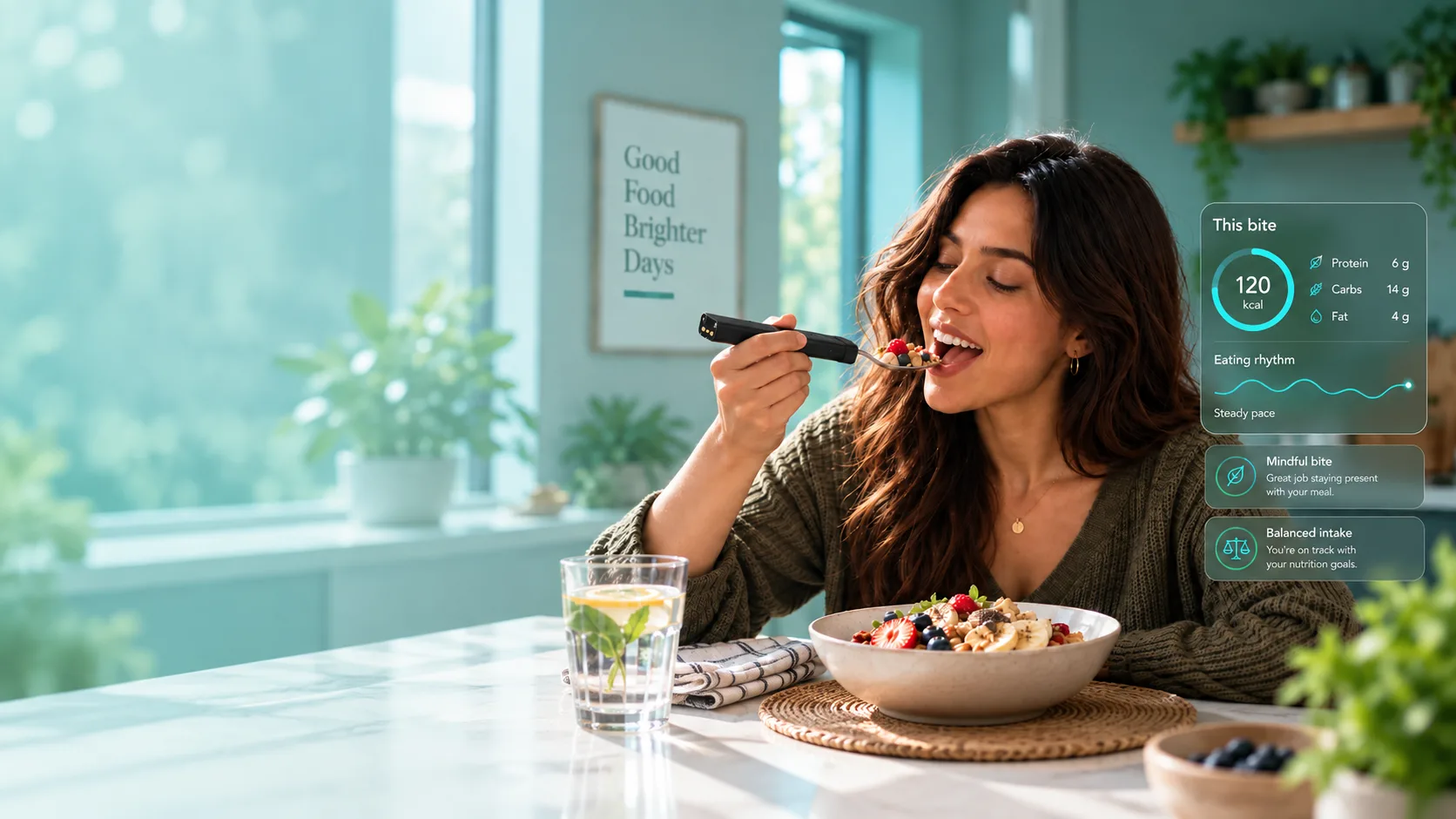
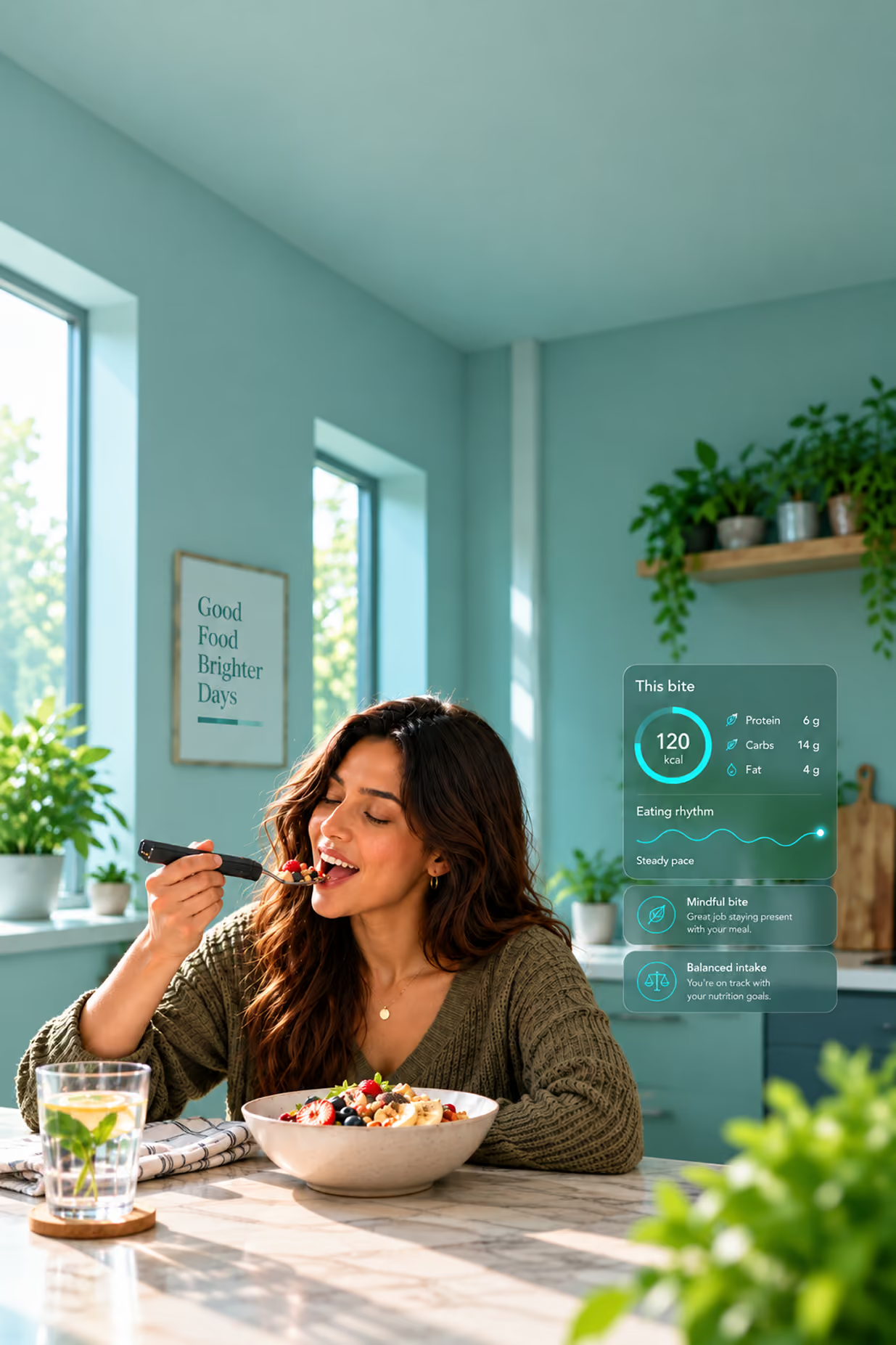
Eating behavior analysis built from real bites, not recall.
Calories explain the fuel; behavior explains the habit. BiteQ's motion sensor reads eating pace, bite size and meal duration automatically as you eat.
What is eating behavior analysis?
Nutrition tracking has historically focused almost entirely on what's eaten: calories, macros, ingredients. How it's eaten, the pace, the bite size, how long a meal takes, has been much harder to capture, mostly because it requires observing the meal as it happens rather than reconstructing it from a list of ingredients afterward. Most tools built to track diet were never designed to notice behavior at all, which is part of why it stayed invisible for so long.
That gap matters because eating behavior carries information a calorie count doesn't. Two people, or the same person on two different days, can eat an identical meal at very different paces, with very different bite sizes, and those differences are meaningfully linked to how sustainable an eating pattern is over time, independent of what was actually on the plate.
BiteQ's motion sensor is built specifically to capture that missing half. It times every hand-to-mouth movement, which produces pace and, combined with the load sensor, bite size, and tracks meal duration from first bite to last. None of that requires a person to notice or remember anything about how the meal felt: it's measured directly from the utensil's own motion, the same way the load sensor measures weight rather than asking for a memory of it.
This also holds up specifically in the moments people are least able to self-report accurately: at the end of a long day, during a stressful stretch, or simply during an ordinary meal that isn't memorable enough to recall in detail later. The sensors don't need a meal to be noteworthy to measure it well, which is precisely when self-reported behavior data tends to be least reliable.
Because the same three signals, pace, bite size and duration, are captured for every meal without exception, the behavior trends in the app end up covering the full range of how someone actually eats: rushed weekday lunches alongside relaxed weekend dinners, rather than only the meals memorable enough to have been logged by hand.
How does BiteQ measure eating behavior?
Behavior data has always been the harder half of nutrition tracking to capture. Here's what BiteQ measures without asking you to remember anything.

Pace
A tri-axis motion sensor counts and times every hand-to-mouth movement, turning eating speed into a measured signal instead of an impression.

Bite size
The load sensor and motion sensor work together to size each bite, adding a dimension that a calorie count alone can't show.

Meal duration
Session length is tracked automatically from the first bite to the last, without a timer to start or stop.
Who is eating behavior analysis for?
Behavior data tends to matter most for people and roles where self-report simply isn't reliable enough. See the fuller range of people BiteQ is built for individuals to support.
01
Anyone who suspects their eating pace varies a lot, meal to meal. But has no way to actually confirm it beyond a vague impression.
02
People working on eating habits more broadly. Where behavior, not just intake, is the thing they're trying to understand and shift.
03
Researchers, clinicians, and coaches who need objective behavior data. Instead of self-reported recall, which is well known to be an unreliable way to measure something like eating pace.
04
Anyone who has noticed a connection between rushed meals and how they feel afterward. And wants to see whether that connection actually holds up in their own data.
How does direct measurement compare to observation and self-report?
Gathering eating behavior data
Researcher observation
Self-report questionnaire
BiteQ sensors
Where it works
Researcher observationLab or study setting
Self-report questionnaireAnywhere
BiteQ sensorsAnywhere
Meals covered
Researcher observationA handful, under study conditions
Self-report questionnaireMore meals, with declining accuracy
BiteQ sensorsEvery meal the utensil is used for
Accuracy on pace and bite size
Researcher observationObserver-dependent
Self-report questionnairePoor; pace and portion recall badly
BiteQ sensorsMeasured by motion and load sensors
Requires a researcher present
Researcher observationYes
Self-report questionnaireNo
BiteQ sensorsNo
Record produced
Researcher observationDiscrete observations
Self-report questionnaireA retrospective summary
BiteQ sensorsContinuous, per bite
The traditional way to gather eating behavior data is direct observation or self-report: a researcher watching a meal, or a person filling out a questionnaire about how they usually eat. Both are limited, observation is impractical outside a lab setting, and self-report is notoriously unreliable, since people are bad at accurately recalling their own pace and portion sizes after the fact.
BiteQ's sensors remove both limitations by measuring behavior directly, in any setting, without a researcher or a recall-based questionnaire involved. Pace, bite size and meal duration come from the utensil's own motion and weight sensors as the meal happens, which produces a more objective, continuous record than either observation or memory can reliably provide.
The two approaches also diverge in scale. A researcher can observe only a handful of meals under study conditions; self-report can cover more meals, but with declining accuracy the further back the recall goes. BiteQ's sensors measure every meal the utensil is used for, at full accuracy, a combination neither observation nor self-report can practically offer.
What do eating behavior patterns look like once measured?
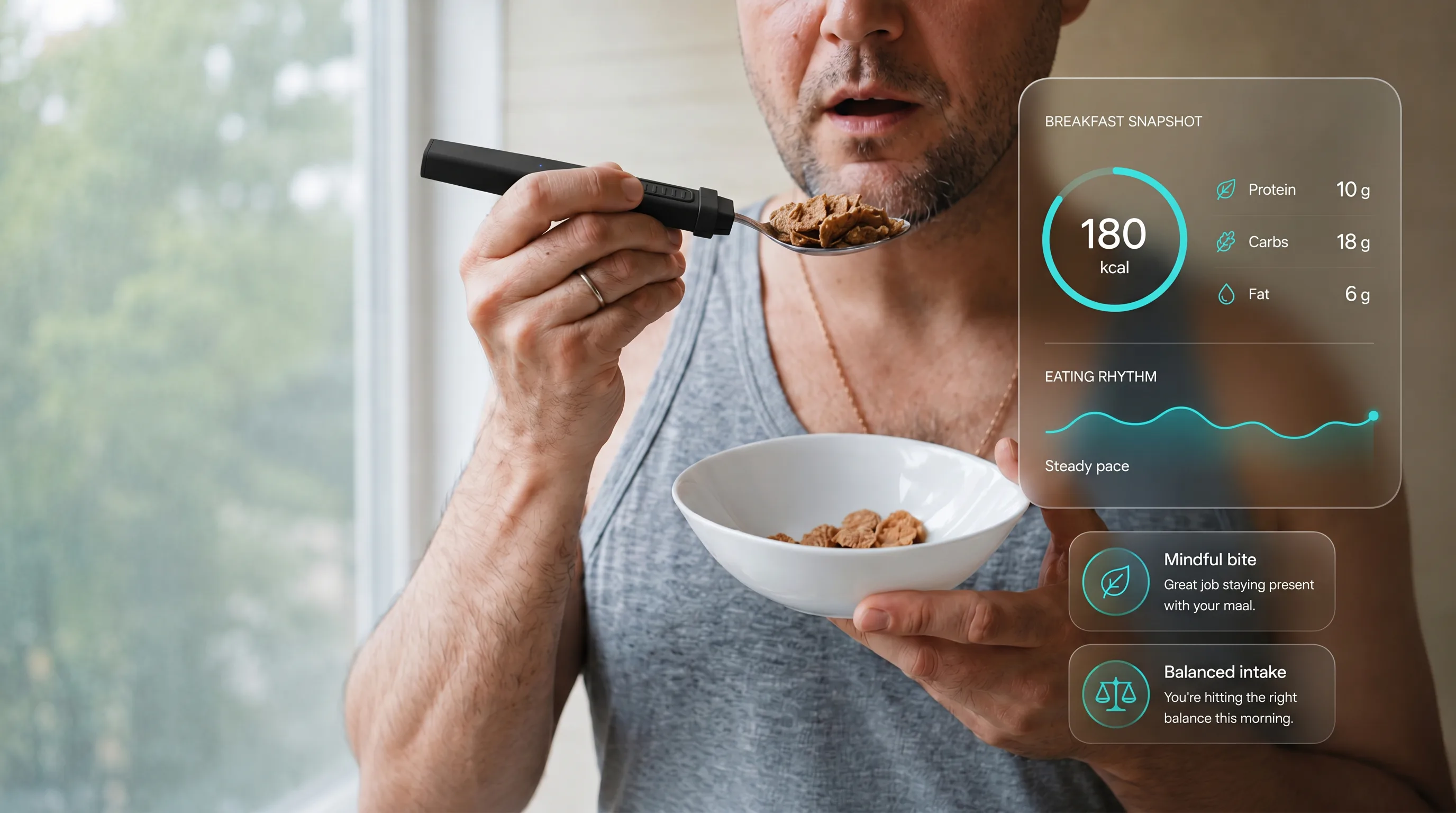
In practice, eating behavior analysis with BiteQ happens without any change to how a meal is eaten. Pace, bite size and meal duration are recorded the same way every time, whether that particular meal is rushed, relaxed, distracted, or fully attended to.
The patterns worth paying attention to tend to appear across meals rather than within a single one: a pace that's consistently faster at certain times of day, a bite size that shifts with certain foods, or a meal duration that's shrinking over weeks without anyone noticing in the moment. None of that is visible from a single meal's data, which is why the behavior trends in the app are built to be viewed over a stretch of time rather than meal by meal.
Behavior data on its own doesn't say what to change, only what's actually happening. What to do with a pattern, whether that's a deliberate change in pace or simply an awareness of it, is left to the person eating, using real data rather than an impression of how they think they eat.
Questions people usually ask
Frequently asked questions about eating behavior analysis
What counts as "eating behavior" in BiteQ's tracking?
Primarily three things: eating pace, bite size, and meal duration. Together they describe how a meal happened, not just what was in it.
How is behavior data captured without a phone or camera pointed at me?
The motion sensor and load sensor are built into the utensil handle itself, so pace and bite size are captured directly from the utensil's movement, with no camera aimed at you. Camera is only used to identify the meal.
Why does eating behavior matter alongside calorie counts?
Two meals with identical calorie counts can differ enormously in pace and bite size, and those differences are linked to how sustainable an eating pattern is. A calorie count alone can't show that.
Can I see behavior trends over time, not just one meal?
Yes. Pace, bite size and meal duration are tracked meal to meal and surfaced as trends in the companion app.
Is eating behavior data useful without also tracking calories?
Behavior data and nutrition data are captured together from the same bites, so in practice they're part of the same picture, but pace, bite size and duration are meaningful on their own as an indicator of eating habits, independent of the specific calorie total.
Can eating behavior analysis show whether my pace changes based on the meal or the setting?
Because pace, bite size and duration are recorded automatically for every meal, patterns across different meals and settings become visible in the app's behavior trends, rather than depending on a person to notice or recall those differences.
How is this different from just timing my meals with a stopwatch?
A stopwatch can capture meal duration, but not bite size or the timing of individual hand-to-mouth movements. BiteQ's motion sensor captures all three simultaneously, which is what allows pace itself, not just total time, to be measured.
Is behavior data shared with anyone, or private to my account?
Meal and behavior data is tied to your account and used to generate your own insights and advisor guidance. BiteQ does not sell personal eating data, and beta participants receive full data handling terms, including retention, export and deletion options, before any device ships.